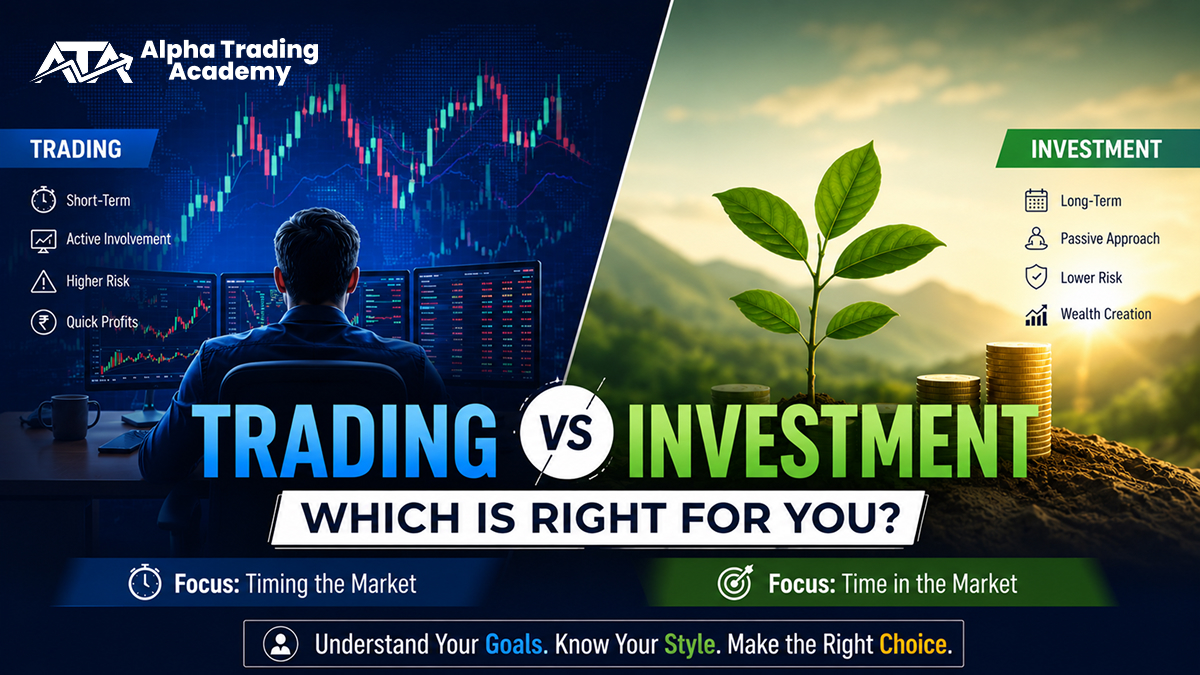
If you are new to the finance world, you must be using words like trading and investments. While beginners often use them interchangeably, they are fundamentally two different concepts. Both involved deploying capital in the market for financial instruments such as stocks, bonds, commodities, and currencies. However, the time frame and tools are different.
Newbies in finance always have one question: Is Trading Better Than Investing for Beginners?
You will get the answer to that question in this post. We will walk you through trading and investments and help you understand their differences. We will also discuss the benefits of fund management vs. self-trading to help you make a better decision for yourself.
What Is Trading?
Trading is the act of buying and selling financial instruments within a short period of time. The goal is to make money from small moments in the live market over few minutes, hours or days.
Different types of traders include:
● Day traders who open and close all their trades in a single session or on the same day
● Scalpers who hold targets small yet frequently gain
● Swing traders who hold the instruments for several days or weeks
Trading demands active participation, practice, and patience. A successful trader must master technical analysis, develop a consistent trading strategy, practice disciplined risk management, and maintain psychological control under pressure.
What Is Investment?
Investing means putting your capital in stocks, mutual funds, ETFs, bonds, real estate, FDs for a long period of time. The idea is to let the capital grow over time, from compound interest, reinvested dividends and asset appreciation.
Investment is ideal for beginners who don’t want to be actively present or are more emotionally vulnerable to the stress of real-time trading. With investment, your capital grows over time and ideally gives higher returns.
Key Differences Between Trading And Investment
Let’s understand the difference between trading and investing through the factors that actually matter.
| Trading | Investment | |
|---|---|---|
| Time frame | Short-term | Long-term |
| Goal | Earning quick profit | Wealth accumulation over time |
| Capital risk | High | Low |
| Potential return | High but inconsistent | Moderate but reliable |
| Attention commitment | Active attention needed | Passive investment |
| Emotional control | Intense control needed | Moderate level control needed |
| Tax | Higher tax on short-term capital gains | Comparatively lower tax on long-term capital gains |
Comparison Of Trading Vs Investing For Beginners
Now we know what trading and investment mean and their difference. So, how do you know which is better for you?
We have listed a few things that will help you determine which is more profitable: Trading or Investing.
Investment is good for you if:
● You want to lock your capital for a long-term (12 to 24 months)
● You want to invest in a long-term goal
● You can’t dedicate time to trading daily
● You want to invest your capital in a low-risk financial instrument
● You don’t want to do stress-filled trading
Trading is good for you if:
● You want to learn how real-time market fluctuations work
● You want to make a daily income from trading
● You can handle short-term losses and trading stress
● You want to risk your capital and time in trading
● You want to build a career in trading
Anyone can be a trader with the right education and mentorship. The majority of traders, especially in forex trading, lose money because they don’t learn the basics and jump right into trading. Programmes offered by Alpha Trading Academy are designed precisely to shorten the learning curve by providing a structured, mentor-led path from fundamentals to live market execution.
If you want to earn from trading but don’t want to do it yourself, you can hire a fund manager. This fund manager will handle your capital and earn profits on a commission basis. Let’s understand which would be better for you.
Benefits Of Fund Management Vs Self Trading
Self Trading
Self-trading is where you handle all your capital and trading. You are in full control of your capital and generate your income through live trading. However, it demands your time, continuous learning, emotional control, and accountability for the losses. It is ideal for those who want to make a full-time career in trading.
Fund Manager
Fund management is ideal for those who want to earn from trading without actively participating. Here, you must allow an expert to do all the trading on your behalf. With this method, you can leverage the expertise of seasoned traders. This is ideal for those who don’t want the emotional stress of daily trading. It is also good for HNIs who don’t have time for daily trading.
Which Is More Profitable: Trading Or Investing?
This isn’t a yes-or-no question. The choice is based on your personal financial goals, your trading knowledge, and your risk management capabilities.
If we compare these two based on returns, trading provides higher returns than traditional investing. Thus, if you have the risk appetite and the necessary knowledge, you can do trading. If you want to enter forex trading, Alpha Trading Academy offers beginner-friendly forex trading courses. Check them out, or contact us with queries.
If you want to play safe and want to hold your capital for a long-time, investment is perfect for you. It doesn’t include the stress of daily trading and provides you with income in the form of returns and dividends.
It is important to mention that trading isn’t all flowers and rainbows. More than 80% traders, especially in forex trading, lose their money and often wipe out their accounts. This isn’t just the market alone, but a lack of emotional control and risk management. If you learn trading psychology and strategies, you can become a successful trader. Check our course to learn analysis, advanced trading strategies, and more.
Conclusion
There is no ‘right’ choice between trading and investments. Trading is a short-term strategy that requires active involvement in emotional control. Investments are long-term strategies where you lock in your capital for compounding over time. Trading is a high-risk strategy, while investment is a low-risk strategy. Your choice depends on your risk appetite, willingness to be involved daily, emotional control, and knowledge about trading. The Alpha Trading Academy courses give you structured, real-world education in how the markets work, how to build consistent strategies, and how to protect and grow your capital like a professional. Explore our courses now.
FAQs
How do traders make a profit?
Traders profit on the shifts in price of financial instruments like currency pairs, stocks and commodities. A trader buys the instrument at a price and sells it at a higher price to make a profit. They can hold the instruments for minutes, hours, days, even weeks.
Is Trading Better Than Investing for Beginners?
Generally investing is more beginner friendly because it involves less real time decision making, less time commitment per day, and is less prone to emotional mistakes in the short term. However, trading can be very rewarding for those willing to invest in proper education and structured practice before trading in the live market.
Is it true that 90% of traders lose money?
Yes, 70-90% traders lose their money because they lack the proper education and strategy for profitable trade. Traders who invest in structured education, develop a consistent strategy, and practice disciplined risk management represent the minority that does achieve consistent profitability. Be part of the minority of successful traders with our structured forex trading courses in India.
How much capital is required to start trading?
There really isn’t some hard minimum amount to start trading. Still, you should check whether the trading platform has any minimum fund requirement, because sometimes they do. You can kick off with ₹500, or even with ₹50,000, it kind of depends on how much risk you’re willing to take, and also on your trading knowhow.