Mastering Trading Psychology: How to Control Emotions and Make Smarter Trades

Forex trading is not just about charts, indicators, and strategies; it’s all about something much deeper in your mindset. You can actually learn every technical pattern; every book can be read, and you can even watch every tutorial, but if your emotions take over while trading, you will still make mistakes. That’s why professional traders say trading psychology is more important than any strategy. Your mindset decides how disciplined you are, how patient you are, and how you handle losses.

What is trading psychology?

Trading psychology refers to your thoughts and emotions that influence your trading decisions. It includes fear, greed, hope or confidence, and patience. Or a trader with a strong psychology can handle pressure, stay calm, and follow a plan. A trader with a weak psychology often becomes emotional and inconsistent.

Why trading psychology is more important than you think

You might believe that trading success comes from finding the right indicator or strategy. Almost every trader loses not because of a bad system but because of emotional decisions. When you enter a trade, you need to check if you enter because the setup is right or because you fear missing out. Do you exit early because you are scared, or do you hold losing trades because you hope the market will reverse? How do you manage risk? Do you increase lot size after a loss, or do you ignore stop losses? Most trading mistakes are emotional, not technical. Mastering your trader mindset is mastering trading.

The biggest emotions traders struggle with

Fear

Fear can stop you from taking valid trades, and it can make you close winning trades too early. It can also freeze you during volatile markets, and fear usually comes from lack of confidence.

Greed

Greed makes you overtrade, avoid stop loss, and increase lot sizes. Grid is the silent killer of trading accounts.

Hope

Hope might sound really positive, but in trading it is dangerous. Often you might hold losing trades, hoping that they will come back. This leads to bigger losses and emotional stress.

Overconfidence

After a winning streak you might feel invincible. You break rules, take bigger risks, and trade without discipline. Or confidence leads to careless mistakes.

Impatience

Impatience makes you enter early, exit early, and chase trades. It stops you from waiting for high-quality setups. Trading rewards patience, not speed.

Frustration

Losing trades can make you angry or discouraged. This leads to revenge trading, which is almost likely to end up badly.

How to build strong trading psychology?

Why Trading Discipline Matters in Forex Trading

Trading Discipline

Trading discipline is really the backbone of long term success in forex trading. A disciplined trader always follow his rules, respect stop loss, and try not to take decisions emotionally, even when market is moving fast. Discipline in trading means doing the right thing again and again, even when your emotions telling you to do something else. Without trading discipline, most traders start overtrading, increase lot size without thinking, or close good trades too early because of fear. It is about waiting patiently for good setups, accepting losses calmly, and sticking with your trading plan no matter what happens in market. When discipline in trading is strong, traders avoid revenge trading and unnecessary risk, which slowly leads to better decisions and steady growth over time.

How Alpha Trading Academy helps you build mindset skills?

Alpha Trading Academy teaches strategies and also price action but also trading psychology.

Mindset training sessions

Live sessions focus on handling losses, staying calm, and managing stressful stuff next when emotional pattern recognition

You can learn to identify when emotions are influencing your decisions.

Practical rules for discipline

You can build habits like setting risk limits, avoiding over-trading, and following a strict routine.

Guidance from experienced mentors

Mentors share the struggles, mistakes, and how they overcame emotional challenges.

Community support

Having a supportive group reduces stress and helps you stay motivated.

What happens when you do not control your emotions?

If trading psychology is ignored, problems arise like you chase trades, you overtrade, or you increase a lot size out of frustration; you can close trades too early, or you hold losers too long. Your emotions become the driver, and that leads to chaos.

What happens when you master your emotions?

When psychology is strong, everything becomes easier. You wait for good setups and follow your trading plan. This also helps you avoid gambling when you trade with patience. Success comes naturally when your mind is stable and you follow forex discipline.

So mastering trading psychology is the most important step in becoming a successful forex trader. Strategies and tools matter, but your mindset decides how well you use them. A disciplined mind can turn every strategy into profits, and an emotional mind can turn the best strategy into losses. By controlling fear, greed, and impatience, you gain the clarity and confidence needed to make smarter trading decisions. With the right guidance, like the psychological training provided at Alpha Trading Academy, you can build the emotional strength required to succeed in forex trading.

FAQ

Why is trading psychology more important than strategy?

Because emotions influence how you execute strategy, even the best strategy fails if you trade with fear or impatience. Strong psychology ensures consistent execution.

How do you stop overtrading?

Create rules limiting your number of trades per day, and avoid trading after emotional losses, and wait only for setups that match what you are trying to do. Focus on quality over quantity, as this helps you reduce overtrading.

How can you manage fear and trading question marks?

You can use a proper risk management trade with small risk and trust your strategy. Fear reduces naturally when your risk is under control and stops losses in place.

How to Build a Career as a Professional Forex Trader in India

Forex trading has become one of the most popular career choices among young Indian students. With flexible hours, global market exposure, and the potential to earn from anywhere, forex trading attracts students, working professionals, and entrepreneurs at the same time. But here is the truth: building a successful career in forex trading It’s not about luck; it’s all about discipline and the right education. If you dream of becoming a full-time forex trader in India, this guide is just for you.

Can forex trading be a career in India?

Yes, forex trading can be a career but with the right approach and understanding of rules. In India currency trading is legal when done through authorized brokers and specific currency pairs regulated by SEBI and RBI. You can trade USD and INR, BP and INR, and INR and JPY and INR. You can also trade major global pairs through international brokers. Many Indian traders do this. But remember, forex trading is not gambling. It is a profession that requires training patients and a strong mindset.

Why is forex trading becoming a popular career in India?

Low starting capital

You don’t need a lack to start. A lot of brokers allow micro accounts or funded programs.

Ability to trade from anywhere

All you need is a laptop or a phone, an Internet connection, and a good strategy.

No boss, no fixed schedule

You decide when to trade, how long to trade, and what to trade. It offers you freedom.

Unlimited growth potential

With skill and experience, your income grows. A lot of professional trainers work with prop firms and manage investor accounts. 

Access to global markets

Forex is the largest financial market. More than $6 trillion is traded every day. Anyone with the right knowledge can participate.

Skills you need to become a professional forex trader

Forex is a skill-based career. The more you learn, the better you earn.

Understand the market structure

You need to learn to read trends, support and resistance, and breakouts. This will help you understand the market direction.

Technical analysis

You should be comfortable with standards, check patterns, indicators, chart patterns, and entry or exit strategies.

Smart money concepts

Understanding institutional concepts like liquidity or over blocks. It helps you trade like professionals.

The risk management

This is the most important skill. You must learn a lot about sizing, stop-loss strategies, and risk-to-reward ratios. Good traders protect capital first and profit later.

Emotional control

A forex trader must engage in a fair grade of overconfidence. Trading psychology is 70% of success.

Consistency and discipline

The only real difference between successful and failing traders is consistency.

Steps to build a career as a forex trader

Get proper education

Don’t rely on random YouTube videos. Professional training shortens your learning curve. You can learn from Alpha Trading Academy online courses or mentorship programs. A strong educational foundation is the first requirement for a forex trader job.

Learn the basics thoroughly

Before placing any trades, understand what forex is, how currency pairs work, and what spreads and leverage mean, the basics build confidence for trading.

Start with demo trading

You can use a demo account to practice without risk. You can learn platform usage, chart trading order types, and strategy development. It is one of the most important parts of forex education in India. You need to practice at least for one or two months.

Build 1 good strategy

Don’t jump between strategies. You can choose one and master it. For example, you can choose fraction action strategy and a breakout strategy. A single strong strategy is better than 10 weak ones.

Learn risk management

Never risk more than 1 to 2% of your trade. Always use stop loss and keep a daily loss limit. Avoid revenge trading. Risk management keeps you in the game.

Track your trades

You can use a journal to record why you entered, why you exited, and how you felt. This improves performance faster than anything.

Continue learning

Forex changes everyday. You can stay updated by joining webinars and backtesting your strategy. You can even learn new concepts. Continuous learning means continuous improvement.

Career opportunities for forex traders in India

If you want to start trading as a profession, then you can check out some career opportunities.

Professional trader with a prop firm

You can get funded by companies that give traders capital and share profits. This allows you to trade big amounts without risking your own money.

Challenges you must be prepared for

Prices move fast, emotionally and financially challenging. Every trader faces losses. And how you handle them defines your success. Fear and greed are your biggest enemies, so you need to manage them. New traders rush, but professionals wait.

How Alpha Trading Academy helps you build a forex career?

Alpha Trading Academy is one of the best choices for Indians who want structured practical forex education. They help you understand the market structure, loan price action, and smart money concepts. You can practice on demo and live accounts and even build strong risk management strategies. The Academy makes your journey smoother and faster, helping you grow from a beginner to a confident professional.

Tips to become a successful forex trader in India

You don’t need to trade to impress others or risk money you cannot afford to lose. You should not rush into live trading and avoid overthinking the market. Protect your capital at all costs and review your trades every week.

So building a career as a professional forex trader in India is absolutely possible, but it requires the right education, patience, emotional discipline, and a commitment to continuous learning. Forex is not a get-rich-quick plan; it’s a skill that grows with time. If you stay focused, practice regularly, and follow smart risk management, you can build a stable and rewarding career in forex trading. The journey may be challenging, but with the right audience, like the training provided by Alpha Trading Academy, you can become a confident and professional trader.

FAQs

Is forex trading legal in India?

Yes, forex trading is legal when done through SEBI-regulated brokers and INR currency plans.

How much money do you need to start a forex trading career?

You can start with as little as ₹1000 to 5000 for practice. Serious traders usually begin with ₹10,000 or even more or join funded programs to trade with external capital.

Can forex trading become a full-time career?

Yes, many Indians become full-time traders, but it takes time, discipline, and skill building. Most traders start part-time and transition to full-time once they are consistently profitable.

Top Mistakes New Forex Traders Make and How to Avoid Them

Starting your forex trading journey is exciting. You watch the charts move, you place your first few trades, and your dream of becoming a successful, confident trader of All Star quickly fades when you realize something important: forex trading is simple but not easy. New traders often make the same mistakes that cost them money, confidence, and motivation. The good news? Almost all of these mistakes can be avoided with the right guidance. In this guide you can learn everything about common forex trading mistakes.

Trading without a plan

This is one of the biggest trading mistakes that traders make. Just imagine starting a road trip without knowing your destination. Sounds chaotic, right? That is exactly what trading without a plan feels like. You might open trades based on guesswork, impulse, or random YouTube videos. A training plan includes entry rules, exit rules, risk per trade, and psychology guidelines. You can also understand when to trade and when not to trade. You can avoid this mistake by creating a simple trading plan and following it back, and test your plan before using it and also avoid entering trades without a clear vision. Your plan is your road map. Without it you will get lost very fast.

Risking too much on one trade

This is one of the biggest reasons a lot of new traders blow their accounts. There is 20% of their account or half of their account. Why? Because everyone wants to make money fast. But forex doesn’t reward your speed; it rewards your discipline. A smart reader risks only 1 to 2% per trade. You can use a risk calculator to decide the lot size. Never trade without knowing how much you risk. Remember, protecting your capital is more important than ever growing it. Small risk means long-term survival.

Trading without a stop loss

You might think if I don’t set a stop loss, the market would eventually come back. The mindset destroys accounts. Without a stop loss, small losses become big losses and you panic. You just hold losing trades for days, and you lose control. A stop loss protects you from emotions and unexpected moves. You can avoid the mistake by always setting a stop loss, even for small trades, and placing the stop loss based on market structure, not random numbers. Stop loss is equal to your safety shields.

Overtrading

Overtrading happens when beginners trade out of excitement or trade because they are bored with revenge trading. Don’t want to miss a move or take trades without analysis. This leads to emotional decisions and unnecessary losses. You can avoid the mistake by trading only when your setup appears and limit yourself to one to three good trades a day. Remember, quality is always more important than quantity.

Chasing the market

You might jump into trades too late because you fear missing out. For example, if a big candle moves up fast, you might think it’s going up just by looking, but by the time you enter, the move is almost over. This leads to loss and emotional frustration. So you should never chase candles, wait for a pullback, and always follow your strategy, not excitement. The market will always give you new opportunities; do not chase old ones.

Using too many indicators

You might even fill your chart with RSI or moving averages and Bollinger bands. Too many indicators create confusion. You get mixed signals and lose clarity. You can avoid the mistake by keeping your chart clean and using one or two indicators maximum. Focus on price function and structure. Simple charts mean clear decisions.

Ignoring market structure

Market structure tells you whether the market is trending up, down, or sideways. You can often ignore it and trade against the trend. Then you try to go down or sell the upward and wonder why you are losing. So you can avoid the mistake by always marking highs and lows and trading with the flow of the market, not against it. Structure is our compass; we are always checking it before trading.

Letting emotions control decisions yeah

Fear, greed, excitement, and anger are emotions that destroy trading performance. You can often close trades too early due to fear or add more trades out of greed or even hold losing trades due to hope. These emotional options can just blow up your account in one single day. So you must stick to your plan and not trade when you’re angry or stressed. Take breaks after emotional trades, as discipline is more important than your emotions.

Not keeping or trading a journal

A journal helps you understand why you lost, why you won, and what works and what doesn’t. Most beginners skip journaling because it feels boring, but it is one of the most powerful training tools. You can avoid the mistake by writing down every trade entry, exit emotional results, and review your journal weekly. Just use it to improve your strategy. A journal turns losses into lessons.

Expecting to get rich quick

Forex is not a shortcut to wealth; it is actually a skill just like any profession. New traders often expect instant profits and 100% accuracy. The mindset leads to disappointment and mistakes. So you have to be patient and focus on learning, not earning. Understand that losses are normal. Successful trading takes time, practice, and discipline.

Following others blindly

You might just copy others from Telegram groups or Instagram communities. But every trader has a different risk tolerance and strategy. Popping without understanding always leads to losses. So you need to learn your strategy and trust your own analysis. You grow only when you learn, not when you copy.

Not understanding the leverage

Leverage is powerful but dangerous. One of the most important forex trading tips is using leverage correctly. New traders often use high leverage to grow accounts, but this can also destroy them fast. You can use low leverage until you are confident and understand how leverage affects margin. Control your leverage; do not let leverage control you.

So every new forex trader makes mistakes. It’s a part of the journey. But the traders who succeed are the ones who learn from mistakes, correct them, and build discipline. If you avoid trading pitfalls, you will be 10 steps ahead of most beginners in the market. Remember to trade with a plan and manage your risk and control their motions. Forex rewards those who respect the process, not those who rush.

FAQs

Why do beginners lose money in forex?

Most beginners lose money because they trade emotionally and do not follow a clear plan. With proper risk management and discipline, losses can be reduced.

How much should a beginner risk a trade?

A beginner should risk only 1 to 2% of their account per trade. This protects the accountant and prevents big losses during learning stages.

Is switching strategies a bad idea?

Switching too often is harmful. You should always give a strategy time test properly and only change if you have clear evidence that it doesn’t suit your style.

Price Action Trading: How Alpha Trading Academy Teaches Smart Money Concepts

Every forex trader dreams of understanding the market in a deeper, more professional way. Not just following indicators, not just guessing entries, but actually reading prices, understanding the market structure, and trading with the same logic that major institutions use. This is exactly where price action trading actually comes into the picture, and smart money concepts also make sense. Together, they help you understand why the market moves where it is likely to go next and how to position yourself with precision. At Alpha Trading Academy you can learn price action and smart money concepts step by step. You can start from the basics and slowly build towards advanced analysis. The goal is simple: trade like smart money, not like emotional retail traders.

What is price action trading?

 Price action trading means analyzing the market using only the movement of the price. There are no indicators, no complicated formulas, just clean charts and pure market behavior. It focuses on candlestick behavior patterns, support, and resistance market structure, and trends besides breakouts and retests stop. You can think of price action as learning to read the market’s language. If indicators are subtitled in a movie, then price action is understanding the actual dialogue.

Why is price action so powerful?

It works in all conditions

Trends, sideways market reversals, and price action actually help you see what is happening right now.

It reduces the chart clutter

You no longer have 10 indicators confusing you. Simple charts mean clearer decision-making.

It helps you enter the market with precision

You understand where the market is heading and where the smart money is positioned. You can also check out where liquidity lies and where the best entry zones are.

It creates confidence

When you understand the price itself, you don’t depend on signals or predictions; you just trust your analysis, not your luck.

Introduction to smart money concepts

Smart money concepts are based on how banks, hedge funds, and institutions trade. The big players control most of the market volume, and the actions shape the price movements that you see. As a retail trader, you might lose often because you follow emotional patterns. Institutions win because they follow logic and structure.

Some of the smart money concepts Alpha Trading Academy teaches

Market structure

Market structures are the backbone of the price action. It actually shows you whether the market is uptrending, downtrending, or ranging. If you can read the structure correctly, 70% of your confusion will disappear.

Liquidity

Liquidity is where you place your stop losses, pending orders, and breakouts. Smart money knows this. They target liquidity to grab orders and push prices in a direction. Alpha Trading Academy teaches you how to identify liquidity pools equal to high or low and stop hunt areas. This prevents you from getting trapped like most retail traders.

Supply and demand zones

Supply zones are areas where sellers are strong, and demand zones are areas where buyers are. Smart money enters the market at these zones, not randomly in the middle. Alpha Trading Academy teaches you how to mark zones accurately so you enter when institutions enter and avoid emotional entries.

Order blocks

An order block is the last bullish or bearish candle before a major market move. Institutions place large orders there. It becomes the most powerful area for future entries. Alpha Trading Academy teaches you how to spot real order blocks and how to avoid fakes. You can also understand how to refine entries to get sniper-level precision.

Fair value or imbalance

When the market moves too fast, it creates gaps called imbalances. Price often returns to fill these gaps before continuing. This helps you predict pullbacks and continuation moves, something indicators rarely show.

Internal versus external market structure

Internal structure equals small movements inside the bigger trend, and external structure means the overall direction of the market. Knowing this helps you avoid confusion when the charts look messy.

Break of structure and character

These two concepts tell you when a trend is starting, ending, or reversing. You just rely on the indicators to guess the concept.

How Alpha Trading Academy teaches price action and smart money concepts

Clean charts first, indicators later

You can learn to read raw charts first—no distractions, no templates, just pure forex price analysis. You focus on candle structure zones and liquidity. This builds a strong foundation.

Market structure mapping

Before any entry, you learn to map the trend direction highs and lows, prints of the structure, and zones of interest. This gives you clarity and confidence.

Identifying smart money zones

You’ll learn to mark supply and demand order blocks and liquidity areas. It’s become your decision zone.

Entry-levels

Alpha Trading Academy teaches you different entry models like break and retest order block entry and motivation entries. Entries help you avoid random trading and Internet purposes.

Risk management integration

Price action without risk management is dangerous. Alpha Trading Academy teaches you how to place proper stop loss and how to calculate lot size. You can learn how to set realistic targets.

Back testing and chart  replay

You can practice everything using chart replay tools and historical markets. This builds experience without risking the real money.

Live market sessions

One of the most powerful parts of Alpha Trading Academy is live sessions. You can watch price action unfold in real time and learn why price reacts at certain levels and how to interpret structure changes. The real-time training is priceless.

Why traders prefer price action plus the smart money concept over indicators

Indicators lag behind price. By the time indicators give you a signal, institutions have already moved. Price action plus the smart money concept gives faster and clearer signals because you understand where price wants to go and where smart money will react. It’s like turning on headlights when driving at night, and you’ll see everything clearly. It is one of the best trading strategies that you can actually consider using.

Price action trading and smart money concepts are not just strategies; they are a complete way of understanding the market. When taught properly, they can transform your journey as a trader. At Alpha Trading Academy you can learn how institutions move the market, how liquidity influences price, and how the structure reveals direction. If you want to trade with clarity instead of confusion, logic and emotion, and price action, the smart money concept is the framework that you need.

FAQ

What is price action trading in simple words?

Price action means studying how price moves on the chart without using heavy indicators. You look at the candles and trends to understand where the market might move.

How does Alpha Trading Academy teach the concept of smart money?

Alpha Trading Academy uses clean charts and live sessions. You can learn how to read, structure, and market important zones, understand liquidity, and apply the entry models.

Is price action better than indicator-based trading?

Yes, price action is often more reliable because it shows real market behavior without lag. Indicators can be helpful, but they react after price moves.

Top 7 Tools and Dashboards Every Forex Trader Should Use

Forex trading has become more accessible than ever, but one thing hasn’t changed: the need for good tools and dashboards. In fact, your trading results often depend on the Forex trading tools that you use. They help you analyze the market, understand the price movements, and plan your trades and manage risk. Think of it this way: a trader without tools is just like a driver without a dashboard. You might still move forward, but you won’t know your speed, direction, or fuel levels, and one mistake could cost you a lot. To trade confidently and professionally, you need a reliable trader toolkit. In this guide, you can check out the top 7 tools and dashboards every forex trader should use.

Trading platform
A trading platform is the heart of your trading activity. It is where you analyze your charts, place orders, and monitor for traits. The most prominent trading platforms are MetaTrader and Trader. You love the platform because it’s very easy to use, fast execution is promised, and real-time price movement is promised. It also provides automated trading options and is suitable for both beginners and experts. The platforms work like your main trading dashboard, showing everything that you need on screen, like price charts, indicators, and open positions. If you are serious about trading, you can start by mastering a strong trading platform.

Forex economic calendar
In forex, major news events can change the markets in seconds. A forex economic calendar makes it easy for you to track the important events and prepare for market volatility. Common tools include Forex Factory and Investing.com. The calendar shows you upcoming events and country-specific data or expected versus actual market numbers. The tool is helpful as it avoids trading mornings. It is a key event that helps you plan your entries and price spikes and volatility. A trader who ignores the news is like a sailor ignoring weather reports.


Charting and technical analysis tools
No doubt, trading platforms come with default charting features, and many traders use TradingView for deeper analysis. It is a game changer because you can get a clean chart here, and also easy drawing tools and tons of indicators make it easy for you to check the market. You can perform your analysis and place trades on MetaTrader 4/5. A lot of professionals do this because the charts are more accurate and smoother. You can analyze support and resistance and breakouts. It helps you see the market clearly and make better decisions.

The risk management tools
Risk management is the most important part of trading. Without it, even the best strategy will fail. The tools help you calculate how much to risk for trade, the correct lot size, and stop-loss payment. Because you should never guess your lot size, and a good trader calculates the risk before placing any trade. These calculators help you trade safely and protect your account during volatile movements.

Market sentiment tools
Sentiment tools show what other traders are doing. They help you understand whether the market is mostly buying or selling a currency pair. The sentiment tools reveal the percentage of long versus short positions and market bias. The forex market often moves opposite to the crowd. Sentiment analysis helps you avoid emotional decisions and see the big picture.

Backtesting software
Before you trust a trading strategy, you must test it. Backtesting tools help you check how your strategy would have performed in the past market conditions. You can learn how your strategy reacts to trends and how it behaves in sideways markets. You can also check out the possible losses or expected profits. The tools save you a lot of time and frustration by showing whether a strategy is worth using in real trading.

Forex journaling analytics tools
A trading journal is one of the most underrated tools in forex trading. These forex analysis tools help you track all your traits and identify your strengths and weaknesses. Popular journaling tools show what went right or wrong and help improve discipline. It also reduces emotional trading and helps refine your strategy. A good journal turns into a smarter, more consistent trader.

Why using the right tools makes you a better forex trader?

Data chart signals and other tools help you avoid random trading. The tools also give you clarity so emotions don’t control your decisions. Risk calculations and stop-loss tools always keep you steady. Analysis tools help you create patterns and trends like a professional. You grow faster as a user trader with proper tools as you learn more, lose less, and improve consistently.

So, forex trading becomes much easier when you have the best trading software by your side. Instead of guessing, hoping, or reacting emotionally, you trade with clarity and confidence. Whether you’re a beginner or advanced trader, the tools guide you towards better decisions, smarter risk management, and more consistent results. Invest time in mastering them, and your trading journey will transform.

FAQ’s

Which is the most important tool for a forex trader?

The trading platform is the most essential because it’s where you analyze charts and execute trades. But all tools together create a complete trader toolkit.

Why should you use a forex economic calendar?

Because major news events can cause sudden spikes in price. The calendar helps you avoid unnecessary risks and plan your trades accordingly.

Do beginners also need to use a TradingView?

Yes, TradingView is completely simple, clean, and beginner-friendly. It helps you understand patterns, trends, and price action early in time.

The Importance of Risk Management in Forex Trading

If you talk to any successful forex trader out there, no matter how big or small, they will always say the same thing: risk management is everything. You can have the best strategy, the best indicators, and the best market predictions, but if you don’t know how to manage your risk, the forex market will humble you very quickly. In simple terms, risk management in forex is actually the art of protecting your trading account so you can trade longer, smarter, and with confidence. It’s not just about making profits; it’s all about making sure that you stay in the game. At Alpha Trading Academy risk management is one of the first and the most important lessons that every student learns. Because without it, even the best strategies fall apart.

What is risk management in forex trading?

Risk management basically means controlling how much money you can lose in a day or in a trade. It helps you answer questions like how much will you risk for a trade or where should you place your stop loss? When you manage trading risk, you can actually trade calmly. When you skip the risk management part, every trade becomes stressful, and that’s when emotions take over.

Why is risk management so important?

Main parts of risk management

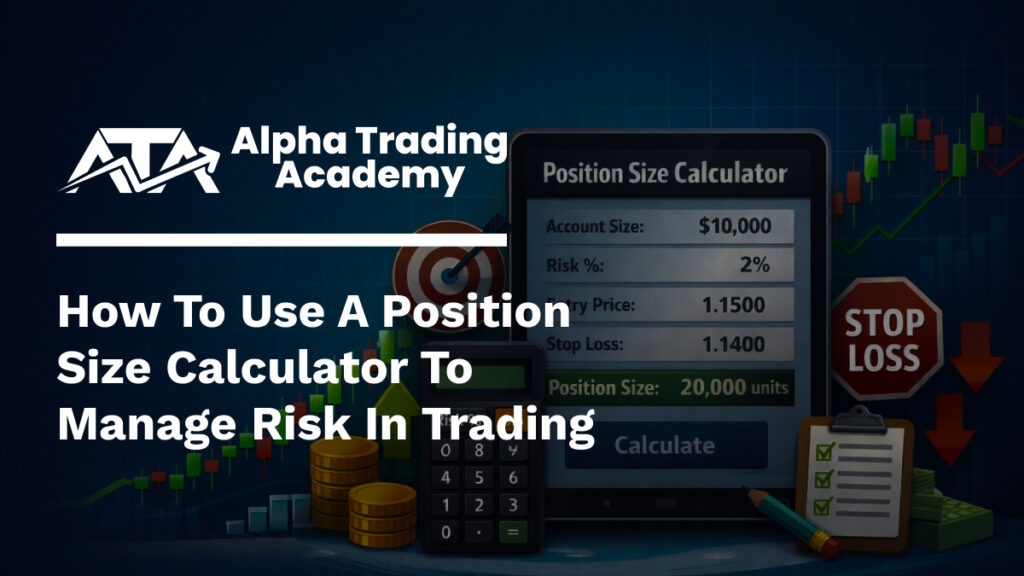
Position sizing

Position size simply means how big your trade is. If your position size is too large, even a small market move can cause a big loss. A simple rule is to risk only 1 to 2% of your account per trade. For example, if you have $1000 in your trading account, risk only $10.00 or $20 per trade. This keeps your account first and safe even when multiple trades go wrong.

Stop loss

Stop loss is one of the most powerful tools in money management in trading. It closes your trade automatically when the price reaches a certain point. Think of it like a seat belt. You might not even need it every time, but when things go wrong, it saves you. Good traders always use stop loss because it controls losses, and it also removes emotional decision-making. It protects your account from big drops. You should never trade without a stop loss. That’s like driving without brakes.

Risk to reward ratio

The ratio tells you how much you risk compared to how much you can win. For example you can risk $10 to make $30, and your risk-to-reward ratio is 1 to 3. Good traders prefer trades with higher rewards than risks. A common recommendation is to aim for at least 1 is to 2 or 1:3 risk-to-reward ratio. This way, even if you win fewer trades you can still end up profitable.

Avoid overtrading

Over trading is when you take too many trades because of excitement, boredom or fear of missing out. This leads to emotional decisions and also increased losses. A simple rule to avoid over training is great quality, not quantity. It’s better to take 2 great setups than just 20 random ones.

Manage your leverage

Leverage can help you earn more with small capital but it can also magnify your losses. A lot of new traders misuse leverage and then blow their accounts. Good risk management actually means using leverage wisely and not overexploiting our account.

Set a daily loss limit

A daily loss limit is the maximum amount you allow yourself to lose in one day. Once you hit that number you stop trading. It is because after a certain point you should take over it is a common approach. Stop trading if you lose 3 to 5% of your account in a day. It’s better to rest and return with a fresh mind.

Stick to your trading plan

A trading plan helps you decide when to enter, when to exit and how much to risk. Without a plan every day trade becomes a guess. Risk management works best when you have clear rules in place.

Psychological side of risk management

It reduces fear:

When you know your risk is small and controlled, you stop panicking about losing money.

It builds confidence

You don’t need to win every trade; you just need to follow your rules consistently. This builds calm, steady confidence.

It prevents revenge trading

Revenge trading happens when you try to recover losses quickly. It is one of the biggest killers of trading accounts. Risk management stops this behavior.

It helps you stay disciplined

Discipline is what separates winning traders from losing traders. Risk management forces you to respect your rules and avoid emotional traits. This also helps you focus on long-term success.

What happens when you ignore risk management?

This is important for you to understand. When traders skip risk control, 1 bad trade wipes out all profits, and fear becomes stronger. Confidence also goes down, and accounts blow up. Most traders quit not because of strategy but because they never learned proper risk management.

How good risk management helps you grow as a trader?

When you manage risk properly, amazing things happen, like you start thinking long term and stop rushing trades. You gain emotional balance as you stay consistent and your account grows steadily.

So forex trading is exciting, but it is also unpredictable. You cannot control the market, but you can control your risk. Risk management is not a rule; it’s a habit, a mindset, and a lifestyle. It protects your capital, strengthens your discipline, and helps you grow steadily over time. At Alpha Trading Academy, risk management is taught with real-life examples and practical tools so you can trade confidently.

FAQs

What is the most important role in risk management?

The most important rule is to risk only a small percentage of the account for trade, usually 1% to 2%.

Can you trade without a stop loss?

It is strongly not recommended. Trading without a stop loss is risky and can wipe out your account quickly. A stop loss protects you from unexpected market moves.

Why do beginners lose money in forex?

As a beginner, you might lose money because you risk too much. At times you might overtrade or let your emotions control your decisions. Proper risk management helps you avoid all the mistakes.

Live Trading vs Demo Trading: What You Learn at Alpha Trading Academy

If you are starting your forex journey, you have probably heard this advice 1000 times: start with a demo account first. And honestly, it’s great advice. A demo account is a safe place to learn, practice, and even explore the forex market without losing real money. But at the same time, every trader reaches a stage where demo trading is not enough. That is exactly when live trading becomes important. The big question is what is the difference between demo trading and live trading at Alpha Trading Academy? This is one of the first lessons new traders understand. The academy teaches you not just how to trade but how to grow from demo to live trading in a smooth, confident way.

What is demo trading?

Before you open your demo trading account, you need to understand what demo trading is all about. It’s like practicing driving in an empty parking lot. You are behind the wheel, you’re pressing the pedals, and you’re turning the wheel, but there are no traffic rules and, most importantly, no risk. A demo trading account gives you virtual money, real market charts, and real-time movement. All trading tools and features are available at zero financial risk. In simple terms, demo trading lets you learn the mechanics of trading without the emotional pressure of losing real money.

What is live trading?

Live trading is the real deal. Now your decisions matter because you are using real money or real funded capital. Everything feels different because your heart beats faster, you think twice before placing a trade, and you feel fear, excitement, doubt, and confidence all at once. Everyone feels rewarded, and every loss feels personal. Live trading teaches you the emotional and psychological side of trading, which is a very important part of the strategy.

Why do both matter in your forex journey?

One is not better than the other; creating builds your foundation, while live forex trading builds your character. Alpha Trading Academy uses both strategies to train the traders because each stage teaches you something unique.

What you will learn from demo trading at Alpha Trading Academy

You understand the trading platform

A lot of beginners feel confused in the first open MetaTrader. On a demo account you can actually safely explore how to place buy or sell orders, how to adjust lot size, and how to read charts. The stages are like learning the controls of your car before driving on the highway.

You practice strategies without fear

Want to test a new strategy? Want to try a different indicator? A demo account is perfect because you don’t have to worry about losing real money. At Alpha Trading Academy mentors often ask students to use a demo to backtest strategies, practice chart trading, and also build confidence. This is actually where your technical knowledge develops.

You build basic discipline

Even though demo trading doesn’t feel emotional, you still learn discipline, following rules, setting correct lot sizes, and avoiding random traits. These habits matter when you switch to a live account.

You understand risk management

A lot of traders risk too much at the start. Demo trading once you understand how much to risk per trade and why stop loss is important. You’ll learn to protect your account before you even risk your real money, which equals turf.

You start seeing market patterns

With time demo trading, teachers recognize trends, pullbacks, and breakouts. The visual money becomes extremely useful later.

What you learn from live trading at Alpha Trading Academy

You discover your emotions

After trading practice, on a demo account, you can get across a side of you that demo trading never touches. You suddenly feel fear of losing, fear of missing out, excitement after a win, overconfidence, and doubt. Alpha Trading Academy prepares you for this emotional journey so you don’t let feelings control your decisions.

You’ll learn true patience

In live forex learning you actually value quality setups waiting for the right moment and sticking to your plan. Patience, it becomes easier to understand when your real money is involved.

You’ll learn to respect risk

When it’s your money, you don’t gamble. You become more careful, more thoughtful, and more disciplined. This is exactly where risk management becomes a part of your personality.

You stop over trading

On demo accounts you take 30 trades a day because they feel nothing. On live accounts, you think twice before clicking buy or sell. Exactly. What Alpha Trading Academy teachers trade is only when it makes sense and not just because you’re bored.

You learn about account protection

Live trading teachers are the most important skill to protect your account; first profits come later. The mindset is really important for long-term success.

You build real confidence

A profitable live trade feels 10 times better than a demo win. It shows you that your skills actually work in real conditions. The confidence keeps you going.

Main differences

Demo TradingLive Trading
No real money at riskReal funds involved
No emotionsStrong emotions
Easy to take tradesHard to take trades
More experimentationMore discipline
Fast learningDeep learning
Perfect for beginnersPerfect for growth

How does Alpha Trading Academy help you transition from demo to live trading?

Step-by-step learning

You first learn theory and practice skills, and then you practice everything on a demo. Only when you are ready do you start live trading.

Strategy development

Mentors help you find a strategy that suits your personality. Some prefer slow and steady, while others like patterns. You learn what works best for you.

Risk management training

You understand how to size your trades, how to protect your card, and how to avoid big drawdowns. It is a core part of the teaching.

Emotional control sessions

Here you are taught how to handle fear, greed, and impulse overconfidence. You’ll learn how to keep a cool mind.

Supportive community

You don’t learn alone; you learn with a group of traders who share your ideas, mistakes, and lessons. The community support makes a big difference.

When should you move from demo to live trading?

You can follow your strategy consistently, and you understand the market movements. You also need to understand that you don’t chase trades or don’t panic during losses. If you feel all of this, you’re ready for the next stage.

Demo trading and live trading are not enemies; they are partners. One teaches just because the other teaches you maturity. At Alpha Trading Academy you can learn how to use both to become a confident, thoughtful, and profitable trader. You can learn how to handle charts, strategies, risks, and emotions. If you are serious about becoming a better forex trader, understanding the difference between demo and live trading is very important.

FAQ

Is demo trading enough to become a good forex trader?

Demo trading is a great start because it teaches you how to use the platform and test strategies. To fully grow as a trader you also need live trading experience because it teaches emotional control and real decision making.

When should you move from demo rating to live trading?

You should switch to live trading when you follow their own strategy consistently and manage risk properly. If you feel confident but not overconfident, you are ready.

Why does live trading feel so different from demo trading?

 Live trading feels different because real money is involved. Or emotions of fear, excitement, and hesitation become stronger.

What is Algorithmic Trading and How Can It Make You a Better Trader?

Have you ever wondered how some traders react faster than lightning when markets move? Before you even click buy they’ve already made the profit and exited. That’s not superhuman speed, that’s Algorithmic Trading also prominently known as algo trading. In today’s stock market more than 70% of the global trades are made by algorithms not humans. Even in India algo trading is growing fast among brokers, hedge funds and even retail traders.

What is algorithmic trading?

Algorithmic gradients using computer primer algorithms trades automatically in the stock market. Instead of just sitting in front of a screen deciding when to buy or sell a software program does it for you based on a set of predefined rules. In simple terms you tell your computer if stock rises above 500 these and volume double s buy 100 shares. The algorithm basically waits watches the market and when those conditions are met boom it executes the trade automatically. No hesitation, no emotion , no delay.

These rules can be based on:

Why Does Algorithmic Trading Exist?

Trading is all about timing and precision. But humans also have some limitations

Computers on the other hand don’t get tired or scared; they execute instantly to trade faster, smarter and more consistently.

How does an Algorithmic trading strategy work?

Build a strategy

Firstly you need to define a strategy, a set of rules for buying and selling. For example when the 50 day moving average crosses above the 200 day moving average sell when RSI goes above 70. This becomes the logic behind your trading algorithm.

Back test the strategy

Next the algorithm is tested on the historical data meaning how it would have performed in the past. This helps you see if your rules actually work before risking the real money if the results look promising the algorithm is fine-tuned for better accuracy.

Execute Trades Automatically

Once the algorithm is live it:

 Who uses algorithmic trading?

User TypePurpose
Institutional InvestorsTo execute large orders without affecting prices
Hedge FundsTo exploit small, short-term opportunities
BrokersTo provide liquidity and faster execution
Retail TradersTo automate their strategies and avoid emotion

At first the trading was used mainly by big players, investment banks, hedge funds and institutional investors. But now thanks to technology and online trading platforms even retail traders can access it instantly.

Types of algorithmic trading strategies

Trend following strategies

These are the most popular; they follow indicators like moving averages, breakouts or momentum. You actually buy when the stock price crosses above the 50 day moving average and sell it when it crosses below. Simple logic and often effective.

Arbitrage strategies

This takes advantage of price differences between two exchanges or markets humans cannot do it quickly but algorithms can in milliseconds.

Mean reversion strategies

This assumes that the price tends to return to the average width time. For example if a stock usually trades around ₹200 but suddenly drops to ₹190.00 algorithm might by expecting it to move back towards ₹200.

Market making strategies

It is basically used by brokers or high frequency traders. The algorithm places buy and sell orders around the current market price to earn small profits from the difference. For example you can buy ₹100 then select 100.10 hundreds of times a day.

Scalping algorithms

Super short term strategy that makes dozens or hundreds of trades per day for tiny profits. It’s all about volume and speed, not holding positions for too long.

Benefits of algorithmic trading

Algorithms react in milliseconds faster than any human can that gives you an edge in the fast moving markets. There is no fat finger mistake, the program executes exactly what your code does. No panic selling, no greed , no I’ll just hold just a little longer. Algorithms basically trade based on data not feelings. You can also test your strategy on years of market data before going live. Because algorithms execute effectively they can help you reduce brokerage and slippage costs.

The risks and challenges of algorithmic trading

If there is even one mistake in your code it could execute wrong traits and cause big losses. Sometimes the traders tune the algorithms to perform perfectly on past data but they fail in real markets. Power cuts, Internet dropouts or server issues can interrupt our execution.

How to start algorithmic trading?

Understanding the trading markets and risk management first is very important. Then you can learn how algorithms work. Many brokers in India now support algorithmic trading through APIs. The platforms make it very easy for you to create algorithms visually, no heavy coding required. Always start small, don’t jump into high frequency or complex strategies. Use historical market data to check if it worked in the past. Most platforms offer back testing features. If it performs well across different times, move ahead. Before using real money, test it in simulation mode. This will help you see how it reacts in real time without losing money once you’re confident deploy your algorithm in the live market, start small monitor performance and improve overtime.

Want to learn algorithmic trading?

If it all sounds exciting but technical don’t worry you can learn it step by step through structured courses at Alpha Trading. Even if you’re a beginner the program can help you understand the technology that drives modern markets.

The world of trading is changing and algorithms are leading the way. Whether you trade stocks forex or crypto automation gives you the edge that manual trading simply cannot match but remember algorithms don’t guarantee profits. This simply helps you trade smarter, faster and more consistently. Start small, learn constantly and build your strategy. And one day you will look back and realize you didn’t just become a trader you became a systematic one.

Fundamental Analysis in Stock Market 

Have you ever wondered how some investors seemed to pick the right stocks, the ones that grow steadily and give returns over the years? Do they have secret insider information but not really what they do have is something powerful: Fundamental Analysis in the Stock Market. If you’re a serious long term investor or want to understand how to find strong companies to invest in, fundamental analysis is very important.

What is fundamental analysis?

Fundamental analysis is basically the process of studying a company’s financial health performance and potential to understand whether its stock is worth buying or not. In simple terms it’s not just about finding the real value of a company, not just the market price. Think of it like this: you are shopping for a phone, you don’t just buy the one that looks shiny, you check the features, battery life and performance before deciding if it’s worth the price. That’s exactly what investors do with the companies through fundamental analysis.

The Core Idea Behind Fundamental Analysis

Every company has two values:

  1. Market Value (Price): What people are willing to pay for its stock right now.
  2. Intrinsic Value (True Worth): what the company is actually worth based on its performance and assets.

If a stocks market rises below their intrinsic value it’s considered undervalued and that’s often a good buying opportunity. If it’s overvalued it might be time to avoid it or even sell it. That’s the goal of fundamental analysis. We have to find undervalued gems before the crowd notices them.

Why does fundamental analysis matter?

In a world full of tips and short term trading noise fundamental analysis gives you clarity and confidence. It helps you invest with logic not emotion. You base our decisions on facts not type. You identify long term winners. It reduces risk when you understand a company’s business and financials you are least likely to panic during short term market swings. You become an independent thinker and you no longer rely on market experts or even social media tips.

Types of Fundamental Analysis

The top down approach is where you start by looking at the bigger picture: the economy, the interest rates and government policies. Then you narrow down to sectors and companies that will benefit most.

Bottom down approach is where you start with two individual companies studying their performance management potential regardless of the broader economy.

Steps to do fundamental analysis

Understand the economy like what the company does, how it makes money and who the customers are. You can find this in the company’s annual report website or Stock Exchange filings. If you are analyzing HDFC Bank you would study how it earns money from its customer base and then compare it to SBI or any other bank.

Study the financial statements like profit and loss balance sheet and cash flow statement. Always prefer companies that generate consistent cash flow and have manageable debt.

Analyze key financial ratio

Ratio NameFormulaTells You About
P/E Ratio (Price-to-Earnings)Market Price / Earnings per ShareWhether the stock is over or underpriced
P/B Ratio (Price-to-Book)Market Price / Book ValueIf the market price is fair compared to assets
ROE (Return on Equity)Net Profit / Shareholders’ EquityHow efficiently the company uses its money
Debt-to-EquityTotal Debt / Shareholders’ EquityHow much debt the company has
EPS (Earnings per Share)Net Profit / No. of SharesCompany’s profitability per share
Dividend YieldDividend per Share / Market PriceHow much return you get from dividends

Study the industry and competitors

No company exists in isolation. The success basically depends on the market it operates in. You need to look at the market size and growth rate, competition and government policies.

Evaluate management quality

A company’s management can make or break its success,  to look for experienced and ethical leadership transparency and communication and consistent business vision. You can also check management interviews, annual reports or even shareholder meeting summaries.

Identify Growth potential

You need to ask if the company has room to grow or is it entering new markets or launching new products. Companies that reinvest profits smartly tend to grow steadily.

Find the intrinsic value

This is where you actually estimate what the company is really worth. There are several methods but Simply put intrinsic value equals to present value of future earnings. If the current market price is less than intrinsic value it’s undervalued it’s a good buy instead of the price is more than intrinsic value it’s overvalued avoid or wait.

Example of Fundamental Analysis in Stock Market

AspectObservation
BusinessIT services, global clients, recurring revenue
Revenue GrowthSteady 10–12% per year
Profit MarginAround 20% — strong
DebtVery low
Cash FlowPositive and consistent
ManagementExperienced, transparent
Industry OutlookGrowing demand for IT & AI services

Advantages of fundamental analysis

It helps you invest, not gamble. You just focus on growth, not short term price moves. By understanding financials you avoid poor quality or low valued companies. You don’t panic during market dips because you know your company’s strength. You can actually find undervalued stocks before they become popular.

Limitations of fundamental analysis

No method is basically perfect. Fundamental analysis actually has some challenges. You need to read reports, study numbers and stay updated. It’s ideal for long term investors not intraday traders.

Learn fundamental analysis the smart way

If you’re serious about investing and want to learn properly consider joining a stock market training course at Alpha Trading. Here you can learn how to read financial statements, understand ratios and analyze sectors. Learning from professionals gives you confidence and helps you make independent decisions.

So at its heart fundamental analysis is not just about understanding the story behind the stock, it’s all about watching its price move up or down. It teaches you to invest in business, not just stocks.

How to Start Trading in the Stock Market as a Student? 

If you are a student and curious about the stock market you are ahead of the game. No doubt most people your age might be busy scrolling Social media. You are learning how to make your own money grow and that’s a powerful mindset, the good news? You can Start learning and even trading in the stock market as a student but only if you do it the right way. In this guide you can learn everything about Stock Market Trading for Students.

Why should you start Trading as a Student?

Let’s be real, school and college rarely teach you how money actually works. You might know physics and algebra but when it comes to investing or trading you have to start from zero. Learning about the stock market changes that. You’ll learn how to grow money not just earn it instead of keeping money ideal you learn how to make it work for you. You build financial discipline like investing regularly teaches you patience and planning. You get more time to learn because you are starting young. You can afford mistakes and learn from them early.

You develop analytical thinking, understanding the market improves your decision making and logical reasoning. It can become a future career as many professional traders and analysts started experimenting as students.  So even if you don’t know much about money right now you can Start learning and preparing and that’s more valuable than rushing blindly.

Understanding Share market basics for students

Before jumping in Smart strategies for student traders in India, you need to understand the basics. Trading simply means buying and selling financial investments like shares, mutual funds,  or currencies usually for short term profits. For example when you buy a share or own a small part of the company if the company performs well and its stock prices rises your investment grows. There are mainly two types of approaches to the stock market. Investing buying it for the long term stop trading means buying and selling frequently to profit from short term price changes. As a student you can always learn both the concepts gradually starting by learning how investing works and then moving to trading once you are comfortable.

Step by step how to start trading as a student

learn the basics first

Before starting  stock trading for students you need to understand how the stock market works. Start with some topics like shares and Stock Exchange. What is demat and trading account besides how to share prices move. You can easily learn all this for free like watching YouTube materials, reading blogs and joining student-friendly online stock market courses.

Open a demat and trading account

To buy or sell shares you need 2 accounts. Demat account stores yourself electronically and trading account lets you buy or sell shares on the exchange. You can open both with a broker. Usually you must be 18 years or even older to open these accounts. If you’re under 18 you can still open one with your parents’ healthy account in their name with you as a minor. Once done you are officially ready to trade.

Popular brokers for students:

Documents you’ll need:

Learn to read the market

Once your account is ready, spend more time observing rather than trading. You need to look at stock prices and how they move daily company news and quarterly results besides basic chart patterns. Don’t worry if it feels confusing at first everyone feels that way.

Starts small with virtual trading

This one is the smartest thing that you can do. Instead of just jumping in with real money you can use virtual reading apps called paper trading. These platforms let you practice trading using fake money but with real stock data.

Start real trading

Once you are prepared and practiced for a few months to understand the basics you can start small, really small. Even 500 to ₹1000 is enough to buy your first share. The goal is not to make big profits, it’s to learn how real trading works. Focus on blue chip or stable companies and avoid penny stocks.

Learn fundamental and technical analysis

Once you have started the real learning begins. Every good trader understands two types of analysis: fundamental analysis and technical analysis. Fundamental means studying the company’s performance revenue profit management and growth potential while technical analysis means studying the price charts and patterns to predict the future movements.

Trading StyleTime FrameIdeal For
Intraday TradingBuy & sell in same dayActive traders
Swing TradingHold for a few daysPart-time traders
Positional TradingHold for weeks or monthsBeginners
Long-Term InvestingHold for yearsStudents & investors

Keep learning

The stock market is a lifelong classroom. Even experienced traders learn something new every day. Make learning a habit, read finance blogs and watch market news.

Common mistakes to avoid 

MistakeBetter Way
Jumping into trading without learningPractice on demo accounts first
Expecting quick profitsFocus on learning process
Ignoring stop-lossAlways protect your capital
Following tips blindlyDo your own analysis
Trading emotionallyStay calm and disciplined
Not tracking resultsMaintain a trading journal

Courses and resources for student traders

If you want to learn trading the right way student structured courses are available. You can join experts at Alpha Trading and start trading classes. You can learn the basics of stock market trading and understand the risk and psychology.

So if you’re a student you have something most people don’t have time. And time is the most powerful asset investing. You don’t need a lot of money to start, you just need curiosity, patience and the will to learn.